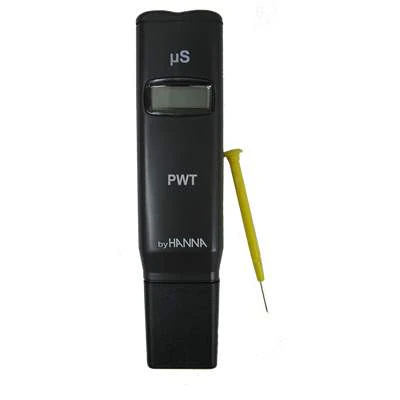
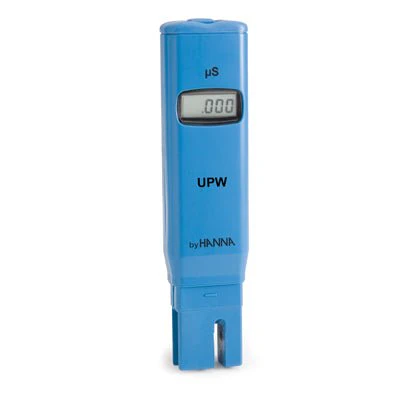
Hanna (HI98309) Pure H2O "UPW" Conductivity Meter 0.0 to 1.999 S-cm
HI98309 Pure H2O "UPW" Conductivity Meter
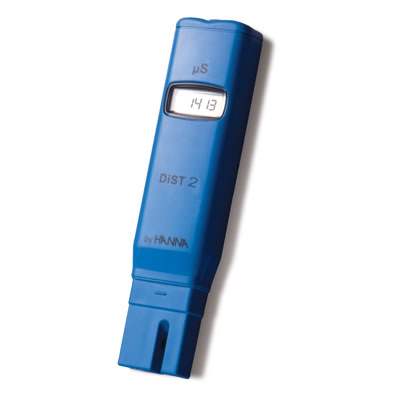
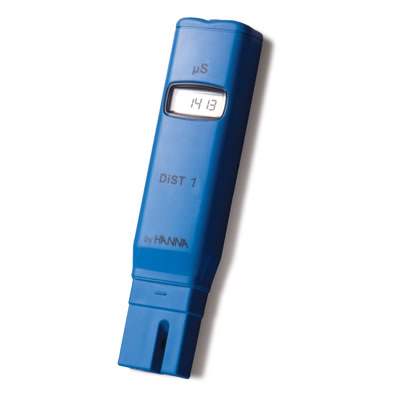
The Hanna HI98309 UPW meter is purpose-built for testing deionized, demineralized, and ultrapure water where conventional conductivity meters lack the sensitivity to detect minute contamination. With 0.001 µS/cm resolution and graphite sensors that resist polarization, it delivers accurate spot checks in pharmaceutical, electronics, laboratory, and industrial ultrapure water systems.
Where Ultra-Low Conductivity Detection Matters
This meter excels in environments where water purity is critical: printed circuit board washing operations, pharmaceutical water systems, laboratory reagent preparation, automotive battery water verification, steam cleaning systems, and any process requiring deionized or distilled water quality assurance. The exposed temperature probe provides fast thermal response, while the durable industrial housing protects the instrument in harsh environments. Factory calibration eliminates setup hassle, and the replaceable probe design extends instrument life without full unit replacement.
Technical Details
| Model Number | HI98309 |
| Measurement Range | 0.000 to 1.999 µS/cm |
| Resolution | 0.001 µS/cm |
| Accuracy | ±2% Full Scale |
| Sensor Type | Graphite (reduced polarization) |
| Probe Design | Exposed temperature probe, replaceable |
| Calibration | Factory calibrated |
| Power | 4 × 1.5V batteries |
| Battery Life | Approx. 250 hours continuous use |
| Operating Environment | 0–50°C (32–122°F), RH max 95% |
| Dimensions | 175 × 41 × 23 mm (6.9 × 1.6 × 0.9") |
| Weight | 95 g (3.4 oz) |
What This Meter Tests
The HI98309 is designed specifically for ultrapure, deionized, distilled, and demineralized water with conductivity below 2.0 µS/cm. It is not suitable for tap water, wastewater, or high-conductivity solutions. Use this meter when verifying reverse osmosis permeate quality, deionization system output, distillation equipment performance, or any application where contamination detection at the sub-microsiemens level is required.
HI98309 Pure H2O "UPW" Conductivity Meter
The Hanna HI98309 UPW meter is purpose-built for testing deionized, demineralized, and ultrapure water where conventional conductivity meters lack the sensitivity to detect minute contamination. With 0.001 µS/cm resolution and graphite sensors that resist polarization, it delivers accurate spot checks in pharmaceutical, electronics, laboratory, and industrial ultrapure water systems.
Where Ultra-Low Conductivity Detection Matters
This meter excels in environments where water purity is critical: printed circuit board washing operations, pharmaceutical water systems, laboratory reagent preparation, automotive battery water verification, steam cleaning systems, and any process requiring deionized or distilled water quality assurance. The exposed temperature probe provides fast thermal response, while the durable industrial housing protects the instrument in harsh environments. Factory calibration eliminates setup hassle, and the replaceable probe design extends instrument life without full unit replacement.
Technical Details
| Model Number | HI98309 |
| Measurement Range | 0.000 to 1.999 µS/cm |
| Resolution | 0.001 µS/cm |
| Accuracy | ±2% Full Scale |
| Sensor Type | Graphite (reduced polarization) |
| Probe Design | Exposed temperature probe, replaceable |
| Calibration | Factory calibrated |
| Power | 4 × 1.5V batteries |
| Battery Life | Approx. 250 hours continuous use |
| Operating Environment | 0–50°C (32–122°F), RH max 95% |
| Dimensions | 175 × 41 × 23 mm (6.9 × 1.6 × 0.9") |
| Weight | 95 g (3.4 oz) |
What This Meter Tests
The HI98309 is designed specifically for ultrapure, deionized, distilled, and demineralized water with conductivity below 2.0 µS/cm. It is not suitable for tap water, wastewater, or high-conductivity solutions. Use this meter when verifying reverse osmosis permeate quality, deionization system output, distillation equipment performance, or any application where contamination detection at the sub-microsiemens level is required.
Original: $542.02
-65%$542.02
$189.71Description
HI98309 Pure H2O "UPW" Conductivity Meter
The Hanna HI98309 UPW meter is purpose-built for testing deionized, demineralized, and ultrapure water where conventional conductivity meters lack the sensitivity to detect minute contamination. With 0.001 µS/cm resolution and graphite sensors that resist polarization, it delivers accurate spot checks in pharmaceutical, electronics, laboratory, and industrial ultrapure water systems.
Where Ultra-Low Conductivity Detection Matters
This meter excels in environments where water purity is critical: printed circuit board washing operations, pharmaceutical water systems, laboratory reagent preparation, automotive battery water verification, steam cleaning systems, and any process requiring deionized or distilled water quality assurance. The exposed temperature probe provides fast thermal response, while the durable industrial housing protects the instrument in harsh environments. Factory calibration eliminates setup hassle, and the replaceable probe design extends instrument life without full unit replacement.
Technical Details
| Model Number | HI98309 |
| Measurement Range | 0.000 to 1.999 µS/cm |
| Resolution | 0.001 µS/cm |
| Accuracy | ±2% Full Scale |
| Sensor Type | Graphite (reduced polarization) |
| Probe Design | Exposed temperature probe, replaceable |
| Calibration | Factory calibrated |
| Power | 4 × 1.5V batteries |
| Battery Life | Approx. 250 hours continuous use |
| Operating Environment | 0–50°C (32–122°F), RH max 95% |
| Dimensions | 175 × 41 × 23 mm (6.9 × 1.6 × 0.9") |
| Weight | 95 g (3.4 oz) |
What This Meter Tests
The HI98309 is designed specifically for ultrapure, deionized, distilled, and demineralized water with conductivity below 2.0 µS/cm. It is not suitable for tap water, wastewater, or high-conductivity solutions. Use this meter when verifying reverse osmosis permeate quality, deionization system output, distillation equipment performance, or any application where contamination detection at the sub-microsiemens level is required.